
Grading the Seahawks' 2026 Draft Class
This weekend, Seattle added eight new rookies to the team, three of which were drafted in the top 100. Here's how I would grade their selections on Day 1 and Day 2, and why.

The Grading Scale
First of all, I need to define my grading scale. Each pick earns a letter grade determined by a point total. Points are earned in three categories: Steal/Reach, Positional Priority, and Board Status. These criteria are described in the following table:
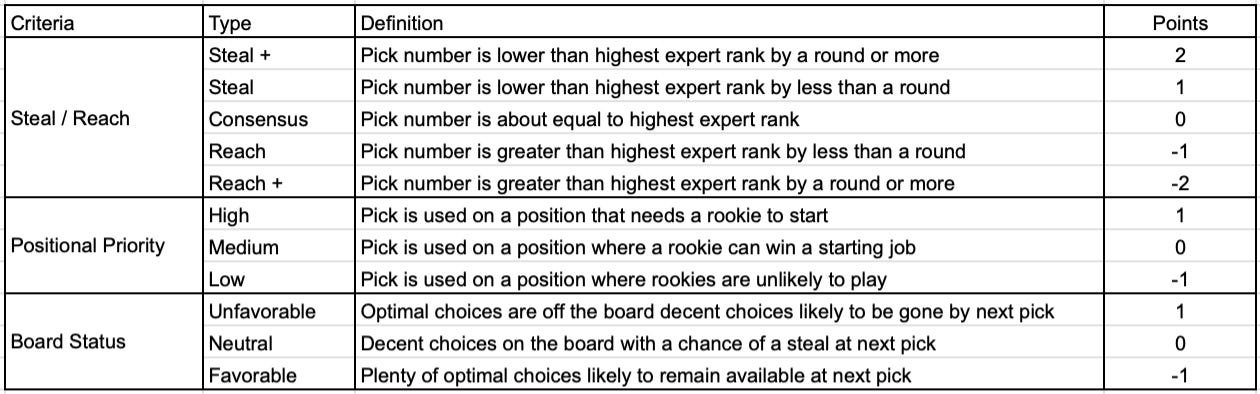
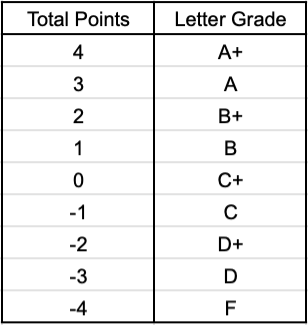
The “highest expert rank” refers to the eight top 100 big boards I’ve collected from industry experts on the NFL draft. The eight boards are Dane Brugler, Daniel Jeremiah, Kyle Crabbs, Bleacher Report, PFF, Tankathon, The Huddle Report, and Draft Board Guru, which historically have some of the most accurate big boards publicly available. The maximum possible points for a pick is 4, for which the letter grade would be an A+. The fewest possible points is -4, which is an F. The point-to-grade conversion is described here:
One thing I should point out is that some grades are more likely than others. For the point totals near zero, there are more combinations of criteria that could lead to those grades. For example, a pick could earn 1 point for being scored as Consensus Rank, High Priority, Neutral Board, or for being scored as Steal +, Medium Priority, Favorable Board. For the point totals far from zero, there are fewer possible combinations that yield those grades. This gives us a normal distribution, or bell curve, for our grading system:
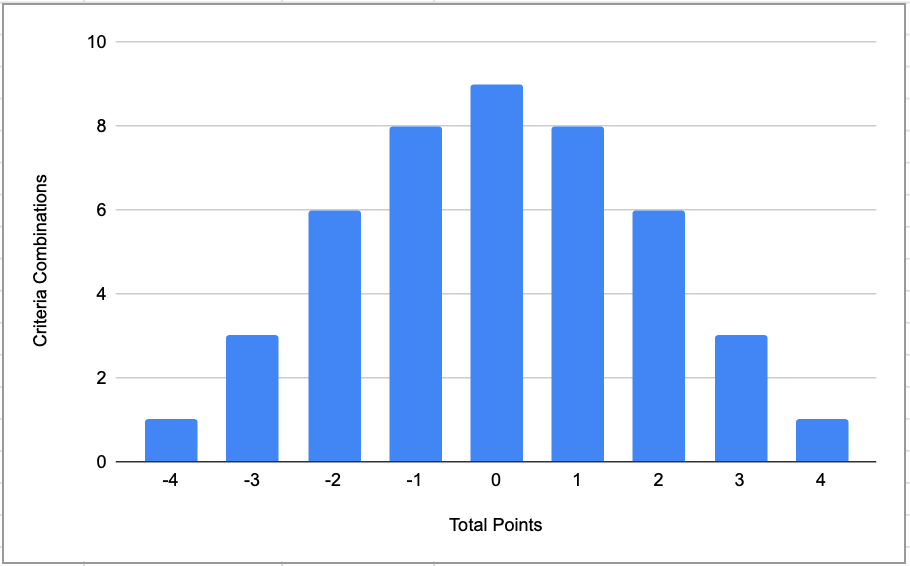
This should make intuitive sense. We want A+ and F grades to be relatively rare and saved for picks that are exceptionally great or awful. What good does a letter grade do to inform us of the quality of a pick if all the grades were to be equally likely?
So, to recap: Each pick is evaluated in three categories, earning points along the way. All the points are added together, and the total points corresponds to a letter grade. Alright. Here we go.
Round 1, Pick 32: RB Jadarian Price (B+)
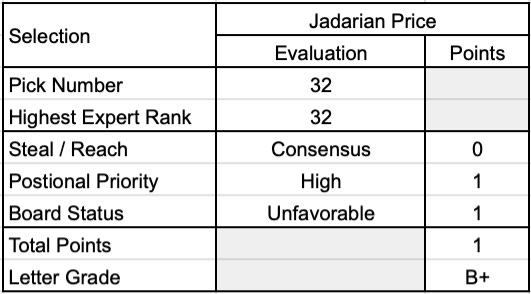
The Jadarian Price pick gets a B+ grade. Let’s walk through the evaluation process. Some may consider this selection a reach, but I would argue that Jadarian Price would have been drafted within the first five picks on Day 2 if Seattle had passed on him. Daniel Jeremiah had him ranked 34th and Bleacher Report had him ranked 32nd. He is described by Jeremiah as a “patient runner with terrific vision and balance.” Bleacher Report graded him as a better prospect than Jahmyr Gibbs in 2023. Running back was a high positional priority for the Seahawks. With Ken Walker departing in free agency, Seattle’s only other back with starting NFL experience is Zach Charbonnet, who has an ACL recovery timeline that points to a possible return around early November. The rest of the depth chart is yet to see significant NFL snaps in a starting role, and as such poses a substantial unknown at the position. Lastly, the board status at pick 32 was unfavorable. GM John Schneider said the Seahawks’ offers to trade down fell apart at the last minute. The two obvious choices at pick 32, safety Dillon Thieneman and cornerback Chris Johnson, were taken at picks 25 and 27 respectively. Moreover, Seattle needed a rookie running back who could start right away. Jadarian Price was the last available one with this type of projection, and he was almost certainly not going to be available at Seattle’s next pick (pick 64).
The B+ grade feels about right. While it’s not an exciting, high ranking player that fell to them at pick 32, Jadarian Price was the most logical choice for the state of the roster and the picks they possessed in the draft. If they passed on him, they would, in all likelihood, be without a starting caliber NFL running back for most of the 2026 regular season. Their other high priority positions of need, safety and cornerback, had their best players taken just before pick 32, and the next best choices were also second round talents. The running back talent cliff in this class was much earlier than that of the defensive backs, so it made sense to address this need first.
Round 2, Pick 64: S Bud Clark (B)
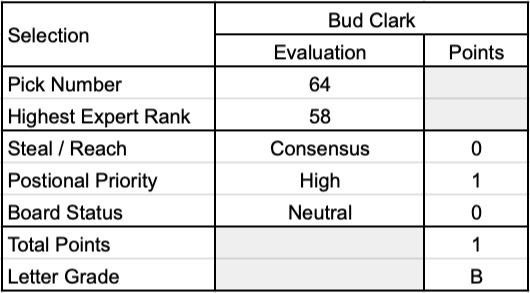
The Bud Clark pick gets a B grade. Daniel Jeremiah and The Huddle Report both ranked him in their top 70, and he was drafted 64th overall. To me, this is another consensus rank, neither a steal nor a reach. Safety is another position of high priority on Seattle’s roster, with Coby Bryant joining the Bears in free agency and little depth behind Julian Love and Ty Okada, the latter of which only achieved playing time as a backup in 2025. Bud Clark projects best as a free safety, which was precisely the role the Seahawks needed to fill with rookie talent. I considered the board status at this pick to be neutral because there were other safeties with similar expert ranks (A.J. Haulcy, Jalon Kilgore, Zakee Wheatley) still available and a chance that one of them lasted until their next pick at 96, but likely not the one they wanted most.
This B grade also seems appropriate. Seattle could have instead gone with a cornerback at pick 64 and a safety and pick 96 and likely come out fine. However, the cornerback class was deeper than the safety class and it was probably wise to take the position with the earlier talent cliff first. They could have gotten a steal in offensive guard Emmanuel Pregnon with this pick, who had expert ranks in the late 30’s and early 40’s, but that position was only a medium priority, whereas safety was more critical to address with higher draft capital. That seems deserving of a solid, above average grade, but nothing too fancy.
Round 3: Pick 99: CB Julian Neal (A)
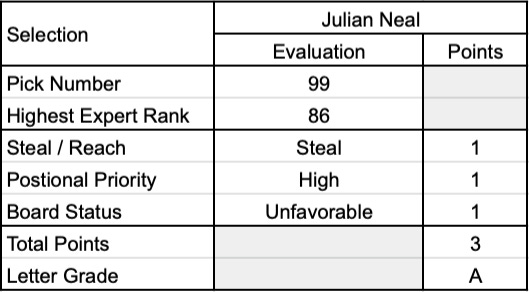
The Julian Neal pick gets the highest grade of the first three rounds, earning an A at pick 99. He was ranked 86th by Daniel Jeremiah and 87th by Bleacher Report, yet Seattle was able to trade back from pick 96 and still get him at pick 99. To me, that’s the definition of a steal. Cornerback was the third of three high priority positions that needed to be addressed with early draft picks, and at this point, the Seahawks already picked a running back and a safety, so this pick needed to be a corner. I scored the board status as Unfavorable because Seattle lacked 4th and 5th round picks this year. Without trading up, they would not be on the clock again until much later in the draft, when all the corners with starting upside would be almost certainly gone.
The A grade for Neal is high, but rightly so. He has great size, length, strength, and explosiveness. He excels at shedding perimeter blocks in run support and making strong open-field tackles, which is something Seattle’s defense values greatly in their secondary players. His stickiness in man coverage at all three levels of the field combined with his long arms to disrupt the catch point make him a near-ideal candidate to fill the role vacated by Riq Woolen’s departure in free agency.
Closing Thoughts
The Seahawks made three top 100 selections and received three grades no lower than a B. That’s good work. And it’s worth noting that these grades are evaluation tools for the process of the picks, not the results of the picks. If Bud Clark becomes an All-Pro safety in his sophomore season, that doesn’t make the B grade wrong. If Julian Neal doesn't make the 53-man roster, that doesn’t make the A grade wrong. It would just mean that, in a specific case, the results did not match the process. We must not be fooled by myopic perspectives. If the process is good, the results will eventually follow as the sample size increases.
Trust the process over the results.
Love this!